Sunday, July 17, 2011

Sunday Starships: Carnivorans

This week our featured starfleet is the Carnivorans from the Galactic Knights line of minis by Monday Knight Productions (originally the Starfleet Wars collection from Superior Models).
 
This felinoid fleet consists of the following ships:
  • Den-class galactic attack carrier
  • Lion-class galactic battlecruiser
  • Panther-class stellar cruisers (2)
  • Cheetah-class stellar destroyer
  • Kitten-class star armored pursuit ships (3)
  • Snarl-class starbombers (3)
 Some of you might recall I had a little accident with the battlecruiser.  Fortunately, I got it all fixed.
The paint scheme for these minis is the result of successive drybrushings of burnt umber, autumn leaves (a kind of orange), and yellow ocher.  Speaking of painting, the deck of that carrier kind of reminds me of a Jackson Pollack piece. 
I want to get some more ships for this fleet--a couple of destroyers, a destroyer leader, another BC and some dreadnoughts.  I also need to paint my Polecat-class super galactic dreadnought, the only Carnivoran ship I haven't painted.  So many projects, so little time.

Saturday, July 16, 2011

Work in Progress: Starfighters

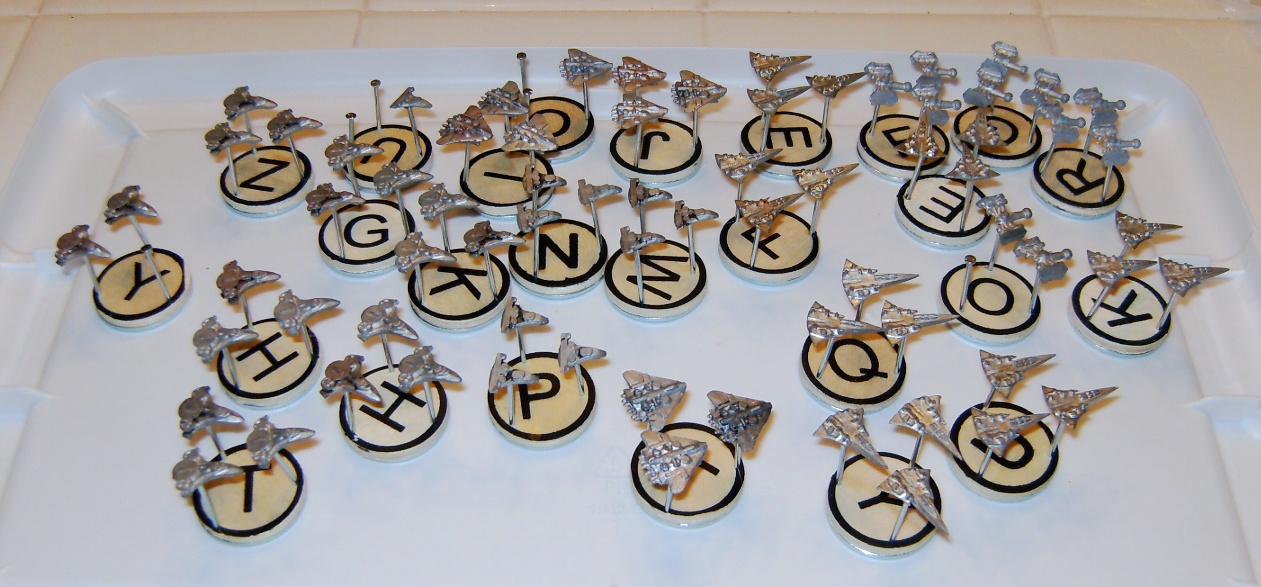
Here are some fighter stands I'm working on.  I'm trying to get all my starfighters for the nonhuman factions of Starfleet Wars/Galactic Knights painted to match their respective fleets.  These are all my unpainted attack craft for the nonhuman factions, which I mounted three to a stand.

I also have a couple dozen more alien fighters that already had paint jobs.  While they were painted to a decent tabletop standard (and I had even glued them to fighter stands and used them in games), they were (a) painted with enamels and (b) didn't match the color schemes of my starships.  They're now soaking in a Pine-Sol bath to remove the paint; they'll join these starfighters in getting new markings.

I also have scores of Terran fighters, painted and unpainted.  While I need to get them all on the same page, color-wise, right know I'm gonna focus on the alien factions.

Since I still don't know what scenario I'll be running at the South Texas Mini-Con, I don't even know if I'll need these fighters for that game.  Still, I've played plenty of battles with lots of fighters, and it will be nice to not have to use the Terrans as proxies for everybody else.

Friday, July 15, 2011

Introducing: the BOX O' DEATH™

I can't take credit for this idea; someone offhandedly referred to a box of death on one of the Battletech blogs I follow (Giant Battling Robots or Paint It Pink; I can't remember), and a bit of Google-fu led me to a description on one of the BT message boards.

Basically, the idea is to save time when you need to roll a whole bunch of dice (not to mention prevent those suckers from flying all over the place, knocking down minis, rolling under the table, etc.).  Instead of making a series of single dice rolls (like when an assault 'mech fires off a dozen medium lasers at once) and tallying up the successes (usually on your fingers), you just shake the BOX O' DEATH™ and read off the results.

Since Starfleet Wars spaceships each get ten percentile die rolls for their Close-In Defense Systems, which translates into a lot of dice rolling, I decided to make my own BOX O' DEATH™ to facilitate gameplay when I run SfW at the South Texas Mini-Con.

As you can see, I took your typical compartmentalized plastic hardware storage box and filed it with percentile dice.  I also labeled each chamber with a letter to keep everyone on the same page when it came to the order of counting die rolls (the red dot is for any "special" roll that may take place).  I plan on using the BOX O' DEATH™ for any game action that requires three or more percentile rolls.  Here are the instructions for operating the BOX O' DEATH™:
  1. Pick up BOX O' DEATH™ and shake it hard four or five times.
  2. Place BOX O' DEATH™ on a flat surface.
  3. Read each roll in alphabetical order, starting with compartment A.
  4. Blacks are always 10s, whites are always 1s.
  5. If additional die rolls are needed, repeat BOX O' DEATH™ procedure.
Hopefully, the instructions will eliminate uncertainty about which set of dice to start with, as well as speed up the game.  Not only that, but I can switch out dice for different games.  Has anyone else used something like this as a time-saver?

Thursday, July 14, 2011

A closer look at Galactic Knights (part 2)

We kicked off our in-depth examination of Galactic Knights with a look at the background and turn sequence, going into detail about movement (drift and maneuver).  Now, we look at the fun stuff--things that make you go boom.

After the maneuver phase comes the combat phase (in the standard rules; the command rules have a separate fighter & missile phase that comes before ship-to-ship combat, but that's for a future post).  To begin combat, the player that won initiative for the turn picks one of his ships, declares all fire for that vessel, and resolves hits.  The other player then chooses one of his craft and does the same thing.  Players take turns shooting with all their ships; when they're done, the turn's over and you start over with drift.

But let's get back to the shooting.  To resolve fire, players roll a 10-sided die for each weapon.  If the roll is equal to or less than the target's profile, the shot hits.  All ships, fighters, and missiles have a profile number ranging from 2 to 8.  The lower the number, the smaller and more nimble the craft.  Likewise, higher profile numbers reflect lumbering behemoths that have a hard time avoiding enemy fire.  A ship's systems can alter its profile in one of two ways.  Shields generate a great deal of electromagnetic hash that lights up a ship on enemy scanners, meaning any vessel with active shields adds 1 to its profile.  On the other hand, electronic countermeasures help defeat target locks, letting a ship that carries ECM subtract 1 from its profile.

Speaking of ship systems, players keep track of a ship's shields, armor, weapons, engines, and so forth on a ship stat sheet, like the one pictured above.  In addition to the fighty bits (shown as rows of boxes for armor and colums with weapons batteries, electronics, missiles, fighters, and engines), each ship has a row of atom symbols denoting critical hits.  This statistic abstracts characteristics like hull integrity, life support, and power generation.  Once a ship loses all its criticals, it's destroyed.

Weapons do a fixed about of damage that attenuates with range.  Powerful beam weapons pack a mean punch at short range (4 hexes), do serious damage at medium range (12 hexes), and can still reach out and touch someone at long range (24 hexes), while the lightest beams are only effective at short range.  Most gun batteries have firing arcs, making facing and maneuver important in the game. 

There are also projectile weapons.  Plasma torpedoes inflict 4 points of damage up to 4 hexes away, and they are fired in salvoes of five; they can be deadly to all but the largest ships.  However, they're dangerous for their own ships as well--if they get take a hit, they explode for one critical hit per torp, enough to destroy anything smaller than a battlecruiser.  Missiles do less damage (3 per missile), but they have several advantages: they have a much longer range (12 hexes), twice as many fit into one systems box, and--most important--they don't detonate when hit by enemy fire.

All this firepower means ships need protection, and they have it.  Shields reduce damage from all incoming fire (but shots bypass shields on a roll of 1 or 2), while armor is ablative--a one-time reduction that gets chewed up by enemy fire. 

Despite a player's efforts and desire, some shots will eventually get through, and this is indicated on the ship stat sheet.  Damage in GK is allocated vertically, not horizontally.  This means each layer of shielding absorbs one point of damage, and each layer of armor absorbs one point of damage.  So for example, if a ship with two layers of shields and two layers of armor was hit by a shot doing 4 points damage, each layer of shielding would soak up a point of damage, and each layer of armor would subtract a point of damage.  Whiile shields can absorb an unlimited amount of damage, each layer of armor is finite, so the player checks off a point from each row of armor for each hit.  If a shot does enough damage to get through shields and armor, it goes to the systems boxes.

As stated above, all the weapons, electronics, and so on are listed in rows of systems boxes.  For each shot that gets past shields and through armor, roll a d10 and look on the stat sheet to see what system is destroyed, starting with the topmost box.  This means ammo magazines are lost, weapons can't fire, and shields no longer work.  If you lose an engine, you no longer can use it during the manuever phase (better hope it's not your only engine!).  If that system box is already gone, or if there is additional damage, mark off the box underneath it.  Once you've gone through an entire column, additional damage that hits that column carries through to the ship's critical hits.  Again, once those critical hits are all gone, kiss your ship good-bye. 

As you can see, combat is pretty straightforward between starships.  However, we haven't looked at fighter and missile rules yet.  Galactic Knights also has two sets of fighter/missile rules, which makes things interesting, and which also means I'll be doing another post on the game at a later date.

Wednesday, July 13, 2011

Another gratuitous spaceship photo

Those of you waiting on the followup to my Galactic Knights review, sorry, but real life intervenes.  I will hopefully get the second part of the review up later in the week.  Meanwhile, here's another gratuitous starship photo (Star Frontiers, Starfleet Wars, and Silent Death ships--can you tell which is which?):
Ciao, y'all.

Tuesday, July 12, 2011

Games at South Texas Mini-Con

The events for our local do-it-yourself game convention are starting to materialize.  Here's a tentative list of games: 

I, of course, plan on running Starfleet Wars.

It looks like Brad from Skull Crushing for Great Justice will run an AD&D game at the con, and he's talking about a one-off where the players take the role of monsters. 

Chris of the Hill Cantons said he wants to run a Tekumel game of some sort. 

It's also looking like we'll have someone running Villians & Vigilantes

I need to confirm that Don M of the Brazos Evil Empire will run When the Navy Walked.

If anyone else would like to run a game, let us know soon!

Monday, July 11, 2011

A closer look at Galactic Knights (part 1)

Not too long ago, I did a four-part series on the long-out-of-print Starfleet Wars set of rules.  Even more recently, a reader requested an in-depth look at Galactic Knights, a game that’s actually still in production and being played (by me, for example).  While an early blog post offered a brief overview of the game, it’s time for a more comprehensive examination of the GK rules.

First, the background: Although the rulebook stats up the spaceship minis that were once known as the Starfleet Wars range, the actual setting for Galactic Knights is different from the SfW milieu.  The book gives the timeline for the battles of the 24th and 25th centuries, “when humanity has made its leap to the stars … and find[s] intelligent alien races equally interested in expansion.”  Notably, while the GK miniature starships range covers five factions (similar to the Five Powers of Starfleet Wars), the main Galactic Knights rulebook only addresses two blocs, the Terrans and the Avarians—details of which appear in sidebars throughout the book.  Two other groups (Entomolians and Carnivorans) appear in their own rulebooks, while the Aquarians have some fan-created material, and that’s it.

In addition to spaceship minis, a bunch of 10-sided dice, and a hex mat, players need stat sheets and a drift marker for each ship.  This indicator is how the game simulates vector movement and serves as an on-the-table indicator of a ship’s velocity.  Each turn consists of four or five phases, depending on whether you’re using the standard rules or the command rules:
  • Drift phase
  • Initiative phase
  • Maneuver phase
  • Fighter & missile phase (command rules only)
  • Combat phase 
The drift marker follows the ship around.  During the drift phase, each player moves his or her ships according to their drift.  To do this, move the drift marker up to the ship’s hex, then move the ship the same number of hexes in the same direction (so if a drift marker is three hexes southwest of its ship, move the marker three hexes northeast to where the spaceship sits, then move the ship three hexes northeast, so the drift marker is once more lies three hexes to the southwest of the vessel).  To quote the rulebook, “Drift is kind of like a ship’s shadow, pushing it along.”  To simulate the physics of a zero-gee environment, drift is unaffected by ship facing and vice versa.

Once all the ships on the board have drifted, it’s time to roll for initiative.  Each player rolls a d10 and adds the total number of functioning sensors in his fleet (up to a max of +4).  The player who rolls the highest can either maneuver half his ships, wait for the other guy to maneuver all his ships, and then maneuver his remaining ships; or the high roller can let the other player maneuver half his ships, then maneuver all his own ships, and after that watch the other player maneuver the rest of his ships.  The winner of the initiative phase also gets to shoot first during combat (more on that later).

To maneuver, you need functioning engines.  Each engine on the ship stat sheet has a number.  Add up the total from all your engines to calculate your available maneuver points (example: a ship with three engines with a 2 rating has a total of 6 m.p.; if it loses one of those engines its m.p. total drops to 4).  A ship can spend its maneuver points in four ways: thrusting, turning, rolling, and counter-thrusting.   
  • Thrusting: a ship can move one hex in the direction it’s facing for every 2 m.p. it spends.  Note the drift marker stays where it is, increasing the drift rate the next turn.
  • Turning: a ship can rotate one hex face for every 1 m.p. it spends.
  • Rolling: a ship can turn upside down (to turn a damaged side away from the enemy) for 1 m.p.
  • Counter-thrusting: a ship can move its drift marker one hex in any direction (thus increasing its drift rate the next turn) for every 1 m.p. it spends.
You can perform any combination of maneuvers in the same phase, as long as you have enough maneuver points to pay for them all.  Once everyone's done maneuvering, it's time to fight.  We'll take a look at GK combat in the next installment of this Galactic Knights review.